

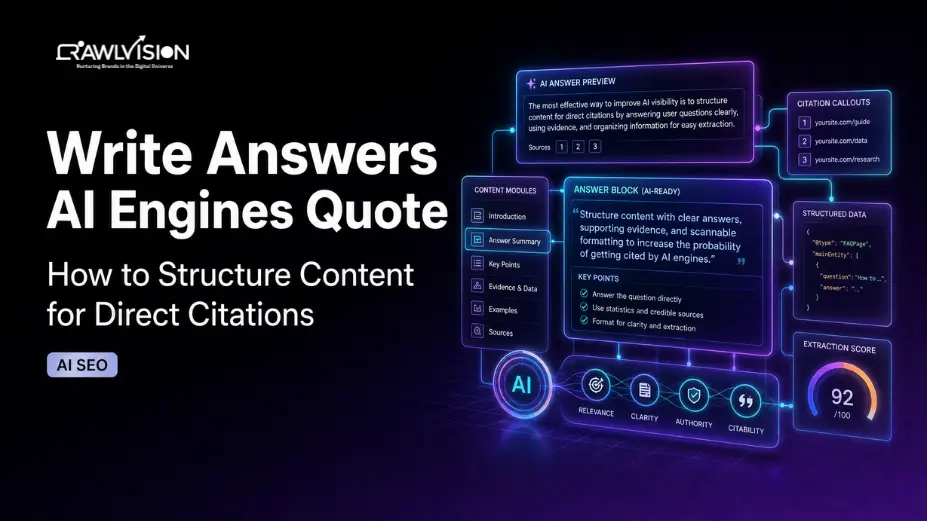
There is a growing gap in digital marketing in 2026: brands know they need to appear in AI-generated answers, but most have no clear strategy for making it happen. The fix is not more content; it is better-structured content. AI engines like ChatGPT, Claude, Perplexity, and Google AI Mode do not browse the way humans do. They extract. They scan your page for directly quotable, clearly structured answers that they can pull into a response without confusion. If your content is not formatted for extraction, it will not be cited, regardless of how comprehensive or well-written it is. This guide gives you the complete, actionable framework for writing structured answers that AI engines actually quote.
Why AI engines need structured answers content to cite you
Understanding why structure matters starts with understanding how AI search engines retrieve and generate answers. Most modern AI search platforms, including ChatGPT with web search, Perplexity, and Google AI Mode, use a process called Retrieval-Augmented Generation (RAG). Instead of relying purely on pre-trained knowledge, these systems actively search the web, retrieve relevant content, and then synthesize an answer from what they find.
When the RAG pipeline processes your content, it does not read it as a human does. It chunks your text into fragments and evaluates whether each chunk directly answers a specific sub-question. Pages with clear headings, short paragraphs, and direct answer-first formatting are far more likely to produce quotable chunks. Pages with dense, essay-style prose produce chunks that are harder to extract cleanly, reducing citation probability.
Research from LLMrefs analyzing over 5.5 million LLM responses found that pages with structured lists, direct quotes, and embedded statistics had 30 to 40% higher visibility in AI-generated responses compared to unstructured pages on the same topic. Structure is not just a formatting preference, it is a measurable citation signal.
The 7 core principles of AI-quotable content
Principle 1: lead with the answer
This is the single most important structural change you can make. AI engines look for direct, extractable answers. If you bury your answer under three paragraphs of background context, the retrieval system may not find it or may extract the wrong section. Every section, every FAQ, and every explanation should begin with the direct answer to the implicit question that the heading raises. Provide the answer first, then support it with context and detail.
Wrong approach: ‘There are many factors that influence how AI engines select content, and researchers have studied this extensively over the past few years, with results that have evolved considerably as the technology has matured…’ (Answer buried several paragraphs later)
Right approach: ‘AI engines select content that leads with a direct answer, uses clear headings, and keeps paragraphs to two or three sentences.’ (Answer first, detail below)
Principle 2: keep paragraphs to two or three sentences maximum
Long blocks of text are harder for AI retrieval systems to parse and significantly less likely to be extracted as a clean citation. The ideal paragraph for AI extraction is two to three sentences: long enough to be meaningful and self-contained, short enough to be pulled as a discrete unit. If you find yourself writing a five or six-sentence paragraph, split it.
Principle 3: use headings that mirror real questions
Your H2 and H3 headings are effectively queries that AI engines match against user questions. A heading like ‘Overview’ tells an AI nothing. A heading like ‘What Is the Difference Between GEO and Traditional SEO?’ matches directly against user queries and signals to the retrieval system that this section contains a direct answer to that specific question. Write headings as questions when possible, and as specific descriptive statements when a question format does not fit naturally.
Principle 4: use the inverted pyramid at every level
The inverted pyramid is a journalism principle: lead with the most important information, follow with supporting detail, and end with background context. Apply this not just to your article as a whole, but to every individual section. AI engines that retrieve your content for a specific sub-query may only extract the first two or three sentences of a section, make sure those sentences are the most valuable.
Principle 5: make every answer self-contAIned
When an AI engine cites your content, it pulls a fragment out of context. That fragment must make complete sense on its own without the paragraphs that came before it and without the paragraphs that follow. Write each answer section so that a reader who sees only that section, with no surrounding context, still gets a complete and useful answer. Avoid references like ‘as mentioned above’ or ‘see the next section’ within answer chunks.
Principle 6: use plAIn, direct language
Bloated corporate language, passive voice, and unnecessarily complex vocabulary all reduce AI extraction quality. Research from GEO experts confirms that AI systems process direct, plain language better than bureaucratic prose. Use ‘buy’ instead of ‘make a purchase.’ Use ‘use’ instead of ‘utilize.’ Use ‘because’ instead of ‘because.’ The simpler and more direct your language, the more easily it can be extracted and quoted.
Principle 7: embed statistics and specific facts
AI engines are drawn to specificity. A sentence like ‘research shows AI search is growing’ is vague and unlikely to be cited. A sentence like ‘according to SEMrush data from September 2025, 93% of searches conducted in AI Mode end without a click to an external website’ is specific, verifiable, and highly citable. Wherever possible, support your claims with concrete numbers, named research sources, and specific timeframes. This signals authority and gives AI engines a factual anchor to extract alongside your analysis.
Content formats that AI engines most readily quote
Beyond the foundational principles above, certain content formats have a measurably higher citation rate across AI search platforms. Build these formats deliberately into your content strategy:
Faq sections with schema markup
FAQ sections are the single most effective format for earning AI citations. Research from CMU’s GEO framework (KDD 2024) identified structured FAQ content as one of the top-five features correlated with higher citation rates across LLM-based retrieval systems. Each question-and-answer pair is a pre-formed, self-contained unit that AI engines can extract directly. The ideal FAQ answer is 50 to 80 words long enough to be informative, short enough to be quoted cleanly. Add FAQPage schema markup so search engines understand the format explicitly.
Definition blocks
Clearly formatted definitions, either with a dedicated ‘What is X?’ heading or a bold-labelled definition statement at the start of a section, are highly extractable. When a user asks an AI ‘What is generative engine optimization?’ the AI looks for the most direct definition it can find. A clearly labelled definition block with a concise, accurate explanation will almost always outperform a definition buried in a general paragraph.
Numbered process guides
Step-by-step numbered processes are among the most cited content formats in AI responses. When a user asks How do I do X?’ AI engines naturally seek a numbered sequence they can reproduce cleanly. Structure instructional content with H3-labelled numbered steps, each beginning with an action verb. Keep each step to two or three sentences. Add HowTo JSON-LD structured data to reinforce the format for search engines.
Comparison tables
Side-by-side comparison content ‘Claude vs ChatGPT,’ ‘AI Mode vs AI Overviews,’ ‘GEO vs Traditional SEO‘ performs strongly in AI citations because users frequently ask comparison-style questions. AI engines retrieve comparison data as structured information. Use clear HTML tables with labelled column headers and concise cell content. Support the table with a brief prose summary below it some AI engines prefer to cite prose explanations over raw table data.
‘Bottom line’ summary boxes
Adding a clearly labelled ‘Key Takeaway,’ ‘Bottom Line,’ or ‘Summary’ section at the end of major content sections gives AI engines a clean, quotable distillation of your core point. These summary statements are highly extractable and often appear verbatim in AI-generated answers because they are designed to be standalone, authoritative conclusions.
Technical and on-page optimizations that support AI extraction
Implement structured data (schema markup)
FAQPage, HowTo, and Article schema are the most directly relevant for AI citation optimization. Schema markup does not guarantee AI citations, but it provides explicit signals to AI retrieval systems about the type and structure of your content, reducing the chance that your content is misclassified or skipped during retrieval.
Ensure AI crawlers can access your content
This is the most overlooked technical issue in GEO and AEO optimization. AI search platforms use their own crawlers (GPTBot for OpenAI, ClaudeBot for Anthropic, PerplexityBot for Perplexity). Check your robots.txt, CDN settings, and JavaScript rendering approach to ensure these crawlers are not inadvertently blocked. Content that cannot be crawled cannot be cited, no matter how well structured it is.
Create an llms.txt file
An emerging best practice for GEO is adding an llms.txt file to your website, a plain-text file that tells AI crawlers which pages are most important and how your content should be understood. While not yet universally adopted, early-mover brands using llms.txt are building a structural advantage as AI crawlers become more sophisticated in how they prioritize and parse content.
Keep content fresh with regular updates
AI search platforms demonstrate a strong recency bias. Outdated content is less likely to be cited, even if it is well-structured and comprehensive. Make a habit of reviewing and updating your most important pages every three months. Even minor updates refreshed statistics, updated examples, and new sub-questions answered signal to AI systems that your content is current and trustworthy.

