

Traditional SEO vs GEO (Generative Engine Optimization) are both essential in 2026. This comprehensive comparison explains the key differences and tells you exactly where to focus your marketing efforts for maximum impact.
The SEO landscape has split in two and you need both
In 2026, the world of search engine optimization has effectively split into two distinct but interconnected disciplines: Traditional SEO, which focuses on ranking in Google’s classic blue-link results, and Generative Engine Optimization (GEO), which focuses on being cited in AI-powered search answers on platforms like Google AI Overviews, ChatGPT, and Perplexity.
The critical insight for every digital marketer this year is this: you need both. They are not competitors, they are complementary. But they require different strategies, different content approaches, and different success metrics. This guide breaks down exactly how they differ and how to allocate your efforts intelligently.
Traditional SEO: what it is and how it still works
Traditional SEO is the practice of optimizing websites to rank in search engine results pages (SERPs) primarily Google’s 10 blue organic link results. The goal is to drive direct, measurable click-through traffic to your website from relevant search queries.
Google still commands over 77% of all search engine queries globally. For businesses that depend on organic traffic for leads, sales, and revenue, traditional SEO remains essential. The fundamentals have not changed: keyword research, quality content, technical SEO, and link building are still the pillars of organic search success.
Generative engine optimization (geo): the new dimension of search
GEO is the practice of optimizing content so that AI-powered search engines understand, trust, and cite your brand in their AI-generated answers. Success in GEO is not primarily measured by website clicks but rather by citation frequency, brand visibility in AI answers, and the brand awareness and authority that AI citation creates.
GEO matters because AI-powered search is growing rapidly. Google AI Overviews now influence millions of searches daily. ChatGPT search has hundreds of millions of users. The brands that invest in GEO now are building visibility in the fastest-growing segment of the search ecosystem.
Read More:- How to Write AI-Friendly Content That Ranks in Generative Search
Direct comparison: traditional SEO vs geo
Primary goal
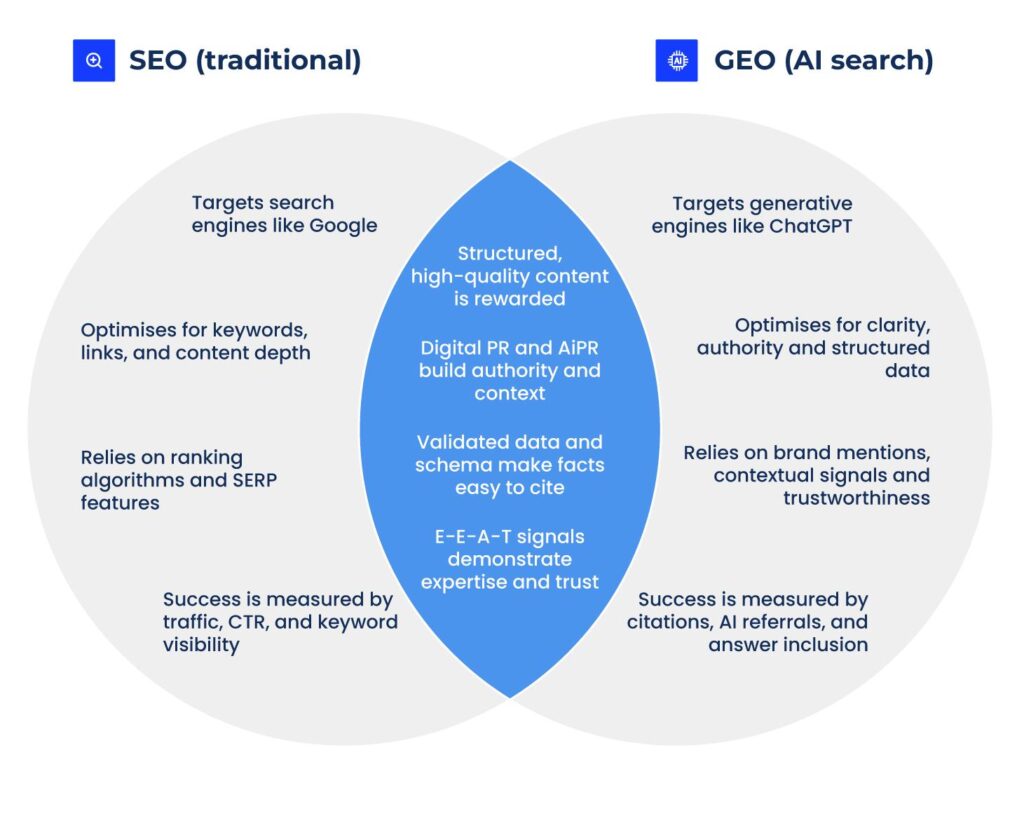
Traditional SEO: Rank in Google’s top 10 organic results and drive click-through traffic to your website. GEO: Be cited in AI-generated answers across multiple platforms; build brand visibility and authority in the AI search ecosystem.
Success metrics
Traditional SEO: Keyword rankings, organic traffic, click-through rate (CTR), conversions from organic traffic. GEO: AI citation frequency, brand mention impressions in AI answers, branded search volume growth, and direct traffic influenced by AI discovery.
Key ranking/citation factors
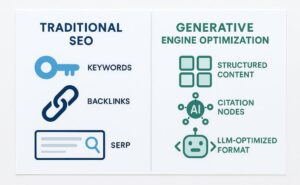
Traditional SEO: Backlinks, keyword relevance, page speed, Core Web Vitals, mobile optimization, and content quality. GEO: Topical authority, E-E-A-T signals, structured data/schema markup, content clarity, entity recognition, brand authority across the web.
Content strategy
Traditional SEO: Keyword-targeted articles, optimized for search intent, structured around specific queries. GEO: Modular, conversational content designed to be easily extracted and summarized by AI; comprehensive topic coverage; question-and-answer format.
Technical requirements
Traditional SEO: Site speed, mobile-first indexing, crawlability, XML sitemaps, canonical tags. GEO: Structured data implementation, entity disambiguation, clean content architecture, bot accessibility (allow GEO-specific crawlers).
Platforms
Traditional SEO: Primarily Google, secondarily Bing and other search engines. GEO: Google AI Overviews, ChatGPT Search, Perplexity AI, Bing Copilot, Claude, and other AI-powered search interfaces.
Time to results
Traditional SEO: Typically, 3 to 6 months for new content to rank competitively. GEO: AI citation can occur faster for well-optimised content, but building consistent AI citation authority is a 6 to 12-month investment.
Read More:- How to Optimize Your Content for Google AI Overviews in 2026
Where to focus your efforts in 2026: a practical framework
- Never abandon traditional SEO Google’s blue-link results still drive the majority of organic traffic and revenue for most businesses.
- Audit your current SEO performance, identify where you are already winning and protect those positions first.
- Add GEO as an extension of your existing strategy. GEO does not require a completely separate workflow; it requires upgrading your content quality and structure.
- Prioritize schema markup implementation. This single action improves both traditional SEO (rich snippets) and GEO (AI citation) simultaneously.
- Rebuild your content strategy around topical authority clusters. This is the highest-ROI investment for both SEO and GEO combined.
- Track AI citation visibility using Google Search Console and manual SERP monitoring for your key topics.
- Invest in E-E-A-T signals, author credentials, brand mentions, and digital PR to improve both traditional SEO and GEO simultaneously.
- Review and update your content regularly. Freshness matters more for GEO than traditional SEO.
The brands winning in 2026 are doing both
The most successful digital marketing strategies in 2026 are not choosing between traditional SEO and GEO; they are doing both, intelligently. The content foundations are largely the same: high-quality, well-structured, authoritative content. The difference is in the optimization layer on top of that foundation.
For traditional SEO: optimize keywords, earn backlinks, fix technical issues. For GEO: implement schema markup, build topical depth, write for AI comprehension. The brands that master both will dominate both the SERP and the AI answer space simultaneously.

