


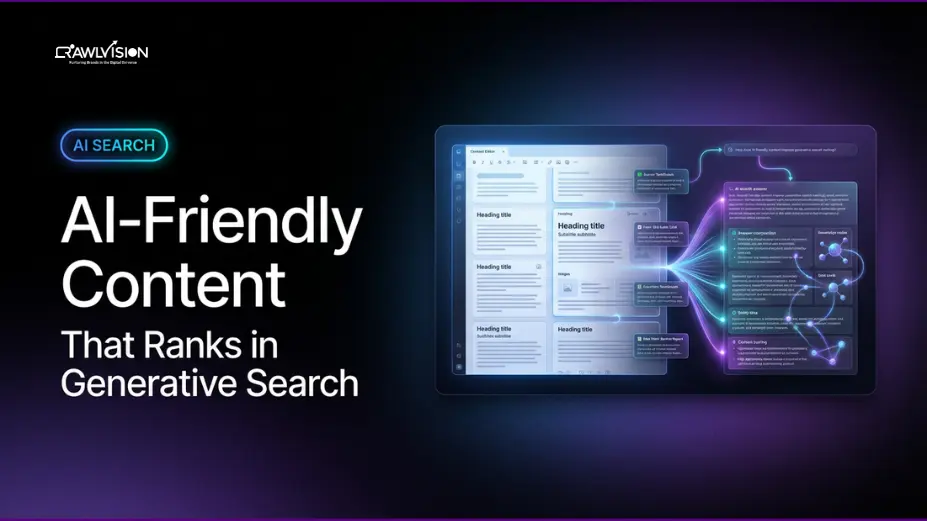
Writing for AI-powered search engines requires a new approach. Learn how to craft AI-friendly content that gets cited in Google AI Overviews, ChatGPT, and Perplexity in 2026.
Why traditional content writing is no longer enough
Content writing strategies that worked in 2020, keyword-dense articles, exact-match anchor text, and generic how-to posts are rapidly losing effectiveness as AI-powered search engines take over.
In 2026, AI systems like Google’s Gemini, ChatGPT, and Perplexity don’t just read your keywords; they understand the meaning of your content, evaluate your credibility, and decide whether you deserve to be cited in their AI-generated answers. Writing for these systems requires a fundamentally different approach.

The 7 principles of AI-friendly content writing
Principle 1: answer first, elaborate later
AI systems are trained to find the most direct answer to a question. Structure your content using the ‘Answer First’ principle: state your direct answer in the first 1–2 sentences of every section, then provide supporting details, examples, and context afterwards. This mirrors how AI expects to extract information.
Principle 2: write in natural, conversational language
Large language models like GPT-4 and Gemini are trained on natural human conversation. Content that reads naturally like an expert explaining something to a colleague performs significantly better than robotic, keyword-stuffed text. Write as you would speak.
Principle 3: create modular, self-contAIned content blocks
AI systems often extract individual paragraphs or sections from a longer article, not the whole piece. Design every section of your content to stand alone as a complete, coherent answer. Each H2 or H3 section should be fully self-contained with its own context, answer, and supporting detail.
Principle 4: demonstrate real experience and expertise
Google’s E-E-A-T framework and AI citation algorithms both heavily reward content that demonstrates genuine, first-hand experience and expertise. Include real examples, case studies, personal insights, specific data points, and expert opinions. AI can distinguish between generic content and content written by someone who truly knows their subject.
Principle 5: use entity-rich language
AI search engines are built on entity recognition, not just keyword matching. Reference well-known entities, specific tools, named methodologies, recognized organizations, and published studies throughout your content. This helps AI systems understand your content’s context and authority within a given topic space.
Principle 6: build comprehensive topic coverage
AI systems favor sources that comprehensively cover a topic rather than superficially touching on many topics. Before writing, map out every question, subtopic, and related concept your reader might have about the subject. Answer all of them in a single, well-organized article or content cluster.
Principle 7: make your content verifiable and trustworthy
Cite credible sources, link to original research, include author credentials, and add a last-updated date. AI systems prioritize content that can be verified and that demonstrates factual accuracy. Unsupported claims or outdated statistics are red flags for AI citation algorithms.
Content structure best practices for AI search
- Use a clear H1 that directly states the topic and includes your focus keyword
- Write H2 headings as specific questions or clear topic statements
- Keep paragraphs short, 2 to 4 sentences maximum, for easy AI extraction
- Use numbered lists for steps and processes; use bullet points for features and benefits
- Include a brief TL;DR or summary section at the top for complex articles
- Add an FAQ section at the end with schema markup. AI systems love FAQ content
- Use tables to compare options, features, or data. AI extracts tabular data efficiently
- Include a clear, definitive conclusion that summarizes the key answer
Read More:-How to Optimize Your Content for Google AI Overviews in 2026
How long should AI-friendly content be?
Length should be determined by comprehensive coverage of the topic, not by an arbitrary word count target. For informational guides and how-to articles, 1,500 to 3,000 words is typically sufficient to cover a topic comprehensively. For complex technical topics or definitive industry guides, 3,000+ words may be appropriate.
More important than length is depth. A 1,200-word article that directly and completely answers every aspect of a user’s question will outperform a 3,000-word article filled with filler, padding, and irrelevant information.