

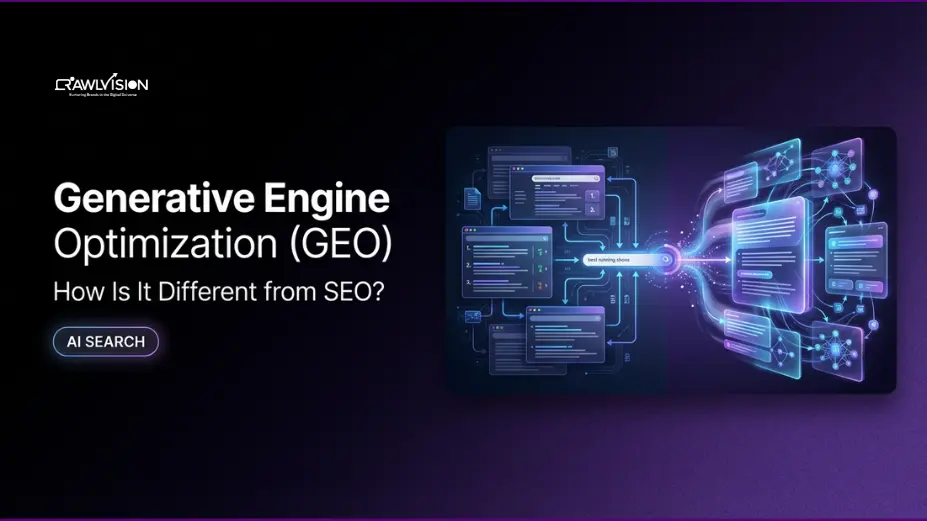
Generative Engine Optimization (GEO) is the next evolution of SEO. This guide explains what GEO is, how it works, and exactly how it differs from traditional SEO in 2026.
Introduction: the search revolution is here
In 2026, the way people search for information has fundamentally changed. Instead of typing keywords and scrolling through blue links, millions of users are now asking AI-powered search engines like Google AI Overviews, ChatGPT, and Perplexity AI for direct answers and getting them instantly.
This shift has given birth to a new discipline in digital marketing: Generative Engine Optimization, or GEO. If you are an SEO professional or digital marketer who hasn’t heard of GEO yet, this is the most important guide you will read this year.
What is generative engine optimization (geo)?
Generative Engine Optimization (GEO) is the practice of optimizing your web content so that AI-powered search engines such as Google AI Overviews, ChatGPT Search, and Perplexity AI understand, trust, and cite your content in their AI-generated answers.
Unlike traditional SEO, which focuses on ranking in a list of blue links, GEO focuses on becoming the source that AI engines extract, summarize, and recommend to users. When an AI system reads your content and includes it in its answer, that is a GEO win.
GEO was formally defined in research published in 2024 and has rapidly become one of the hottest topics in the SEO and digital marketing industry heading into 2026.
How traditional SEO works
To understand GEO, you first need to clearly understand how traditional SEO works:
- You research keywords that people search for on Google.
- You create content optimized around those keywords.
- Google crawls and indexes your content.
- Google ranks your page in the Search Engine Results Page (SERP).
- Users click on your link and visit your website.
In traditional SEO, success is measured by rankings, organic traffic, and clicks. The entire goal is to appear in Google’s top 10 results for your target keywords.
How generative engine optimization (geo) works
GEO operates on a completely different model:
- A user types a question into ChatGPT, Google AI Overview, or Perplexity.
- The AI engine reads billions of web pages, including yours.
- It extracts the most authoritative, clear, and well-structured answer.
- It generates a response and cites the sources it trusted most.
- Your brand/website gets mentioned in the AI-generated answer even if the user never clicks your link.
In GEO, success is measured by citation frequency, brand mentions in AI answers, and visibility in generative search results, not just click-through rates.
Read More:- Traditional SEO vs GEO: Key Differences and What You Should Focus On in 2026
Key differences: geo vs SEO
1. Goal
SEO aims to rank on Google’s SERP. GEO aims to be cited by AI-generated answers across multiple platforms, including Google, ChatGPT, and Perplexity.
2. Ranking signals
SEO relies on backlinks, keyword optimization, page speed, and Core Web Vitals. GEO relies on content clarity, entity recognition, structured data, topical authority, and E-E-A-T signals.
3. Traffic model
SEO drives direct clicks to your website. GEO builds brand visibility and trust even in zero-click environments where users get answers without visiting your site.
4. Content format
SEO content is often keyword-dense and targets specific search queries. GEO content is conversational, well-structured, modular, and designed to be easily extracted and summarized by AI systems.
5. Platforms
SEO is primarily Google-focused. GEO spans Google AI Overviews, ChatGPT, Perplexity AI, Bing Copilot, Claude, and any other AI-powered search interface.
Why geo matters in 2026
According to industry data, AI-powered search now influences nearly 20% of all digital queries. Google AI Overviews appear in an estimated 15% or more of search results. ChatGPT has over 850 million users as of early 2026.
If your content is not optimized for generative engines, you are invisible to a rapidly growing segment of your potential audience. Brands that master GEO early will have a major competitive advantage as AI search continues to grow.
Read More:- Entity-Based SEO: A Complete Guide to Knowledge Graph Optimization
Core principles of geo
- Write content that directly answers specific questions AI loves clear, direct answers.
- Use structured data and schema markup so AI can understand your content’s context.
- Build topical authority by covering your subject matter comprehensively.
- Establish E-E-A-T signals: Experience, Expertise, Authoritativeness, and Trustworthiness.
- Use entity-based optimization to connect your content to known entities in Google’s Knowledge Graph.
- Create modular content, self-contained paragraphs that AI can extract independently.
- Earn citations and brand mentions across authoritative websites.
Does geo replace SEO?
No, GEO does not replace SEO. Traditional SEO is still critical because Google still dominates over 77% of all search queries globally. However, GEO extends your optimization strategy beyond Google’s blue links into AI-generated answer environments.
The smartest marketers in 2026 are practicing SEO + GEO together, ensuring they are visible both in traditional search results and in AI-generated answers.

