

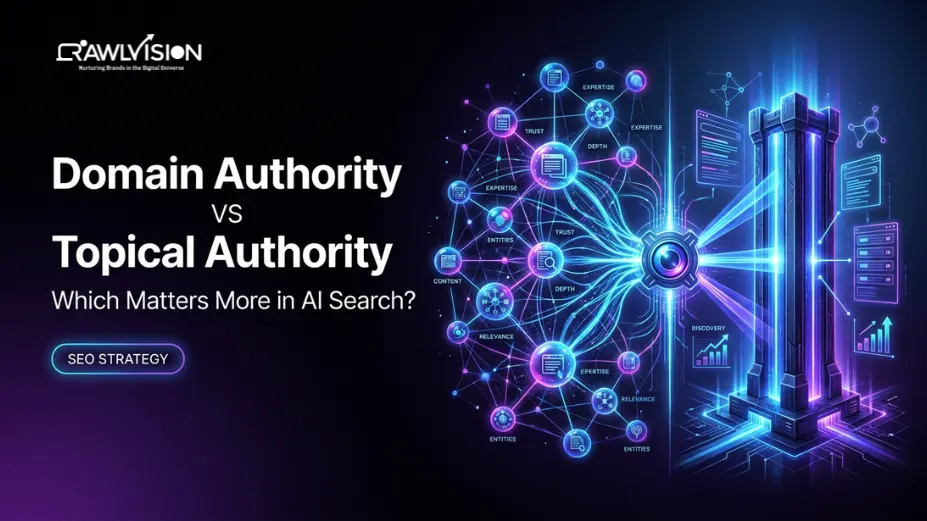
The debate around Domain Authority vs Topical Authority in AI search is reshaping How SEO professionals approach content strategy. For years, a high Domain Authority (DA) score was the golden ticket to ranking on Google. But in 2024 and beyond, with AI Overviews, Perplexity, ChatGPT, and generative search engines reshaping how answers are surfaced, topical authority is increasingly becoming the metric that matters most. This guide breaks down both concepts, compares their relevance in traditional SEO vs. AI-powered search, and tells you exactly what to focus on in today’s AI-first environment.
What is domAIn authority?
Domain Authority (DA) is a score developed by Moz (scale: 1-100) that predicts how likely a website is to rank on search engines. Ahrefs has a similar metric called Domain Rating (DR). Both are calculated based on the number and quality of backlinks pointing to your domain.
A site like Wikipedia or Forbes has a very high DA because thousands of authoritative websites link to it. In traditional SEO, a higher DA often meant better rankings, especially for competitive keywords.
Limitations of domAIn authority in AI search
- DA does not measure content depth or relevance to a specific topic
- AI systems do not use DA as a direct ranking or citation signal
- A high-DA site with thin content may still lose to a low-DA expert site in AI-generated answers
- DA is a third-party metric that Google itself does not use it as a ranking factor
What is topical authority?
Topical authority is the measure of how deeply and comprehensively a website covers a specific subject area. A website that publishes 50 well-researched, interlinked articles on a single topic, such as SEO or digital marketing, builds topical authority in that niche.
Google’s Helpful Content System and AI search engines favour websites that demonstrate genuine expertise through content depth, consistent publishing, and semantic relevance. This is directly tied to the E-E-A-T framework (Experience, Expertise, Authoritativeness, Trustworthiness).
How topical authority is built
- Create comprehensive content clusters around a core topic (pillar + supporting pages)
- Cover every subtopic, question, and user intent within your niche
- Interlink content strategically to reinforce semantic relationships
- Publish consistently with updated, factual, and well-researched content
- Earn citations, mentions, and backlinks specifically within your niche
DomAIn authority vs topical authority: a head-to-head comparison
| Factor | Domain Authority | Topical Authority |
| Measured by | Backlink profile | Content depth & coverage |
| Used by Google | Indirectly (via PageRank) | Directly (Helpful Content) |
| AI Search Relevance | Low | High |
| Build time | Years (link-building) | 6-12 months (content) |
Why topical authority matters more in AI search
When AI systems like Google Gemini, ChatGPT, or Perplexity generate answers to user queries, they do not look up your Moz DA score. Instead, they evaluate the semantic relevance and depth of your content against the user’s question. A website that has covered a topic comprehensively, from beginner guides to advanced technical breakdowns, is far more likely to be cited in an AI-generated answer than a high-DA site with one shallow article on the subject.
Ai systems reward content depth over link quantity
In AI-powered search, the quality and relevance of your content ecosystem matter more than how many websites link to you. This is why relatively newer websites with strong topical authority in AI search are outperforming legacy domains in AI-generated answers and Google AI Overviews.
Semantic understanding is core to AI ranking
AI search engines use transformer-based language models that understand context, co-occurrence, and semantic relationships. A site that covers all angles of a topic, including related subtopics, entities, and questions, trains these AI systems to associate your domain with expertise in that niche. This is the essence of topical authority in AI search.
Does domAIn authority still matter?
Yes, but its role has evolved. In traditional SEO, a high domain authority still gives you an edge for competitive, commercial keywords. Backlinks remain a strong Google ranking signal in standard organic search. However:
- Domain authority alone cannot make up for thin, irrelevant content
- In AI Overviews and generative search, topical relevance outweighs raw link metrics
- A focused topical strategy can achieve rankings and AI citations faster than broad link-building
Think of domain authority as a baseline credibility signal and topical authority as your competitive differentiator in the AI era.
How to build topical authority for AI search: actionable steps
1. Build a topical map
Start with one core topic and map out every related subtopic, question, and user intent. This forms your content cluster. Publish pillar pages for broad topics and supporting articles for each subtopic.
2. Answer every question in your niche
Use tools like Answer The Public, Also Asked, and Google’s ‘People Also Ask’ to identify every question your target audience is asking. Create dedicated content for each. This directly feeds your AEO (Answer Engine Optimization) strategy.
3. Interlink deeply and strategically
Every supporting article should link back to its pillar page, and pillar pages should link to all supporting articles. Strong internal linking signals to both Google and AI systems that your site is a comprehensive resource on the topic.
4. Keep content updated
AI systems prefer fresh, accurate information. Regularly update your existing content with new data, statistics, and insights. Mark content updates with a ‘Last Updated’ date for crawlers.
Geo and AIo optimization for topical authority
Generative Engine Optimization (GEO) and AI Inference Optimization (AIO) both benefit from strong topical authority. When your site is the most comprehensive resource on a topic, AI models are more likely to retrieve, cite, and recommend your content. Combine topical authority with structured data (schema markup), FAQ sections, and clear semantic headings to maximize your visibility in AI-generated results.

