

Rank tracking used to be simple. You plug in your keywords, check your positions, and adjust your strategy. But in 2026, that approach only tells half the story, and for a growing number of search queries, it misses the picture entirely.
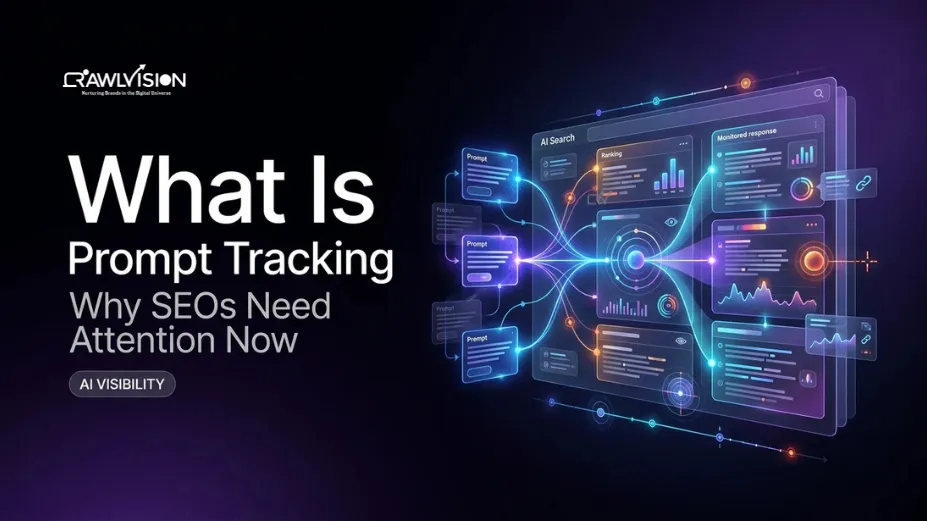
Enter prompt tracking: the practice of systematically monitoring how your brand appears or doesn’t appear inside AI-generated responses across platforms like ChatGPT, Google AI Overviews, Perplexity, and Google Gemini.
If you have never heard of prompt tracking, or you’ve heard the term but aren’t sure why it matters for SEO, this guide will change how you think about search visibility in the AI era.
What is prompt tracking?
Prompt tracking is the process of sending predefined queries called “prompts” to AI search platforms and recording whether, how, and in what context your brand or content appears in the responses.
Think of it as rank tracking, but for AI. Instead of checking if your URL is in position #3 on Google, you’re checking whether ChatGPT recommends your brand when a user asks a question in your niche.
For example, if you run an SEO agency, you might track prompts like:
- “What are the best SEO agencies for e-commerce?”
- “Which tools should I use to track keyword rankings?”
- “How do I improve my website’s topical authority?”
By regularly running these prompts and recording the outputs, you build a clear picture of your AI search visibility and identify exactly where competitors are getting mentioned instead of you.
Why prompt tracking matters for SEO in 2026
The case for what is prompt tracking becomes clear when you look at the data. AI-powered search tools now handle billions of queries monthly. ChatGPT processes over 2.5 billion prompts per day. Google AI Overviews appear on a significant percentage of search queries.
Most critically: AI-generated answers rarely show a ranked list of URLs. They synthesize information and cite sources selectively. If your brand isn’t being cited, users may never even know you exist, regardless of where you rank on traditional search.
Prompt tracking solves this by giving you direct insight into your AI citation performance.
The new visibility gap
Traditional SEO metrics can give you a false sense of security. You might rank on page one while simultaneously being completely invisible in AI-generated answers. This visibility gap is silently costing brands traffic and brand authority as more users adopt AI-first search habits.
Prompt tracking makes this gap measurable, and once you can measure it, you can close it.
How prompt tracking works: a step-by-step overview
Here’s a practical breakdown of how SEOs and digital marketers are implementing prompt tracking today:
- Define Your Target Prompts: Identify 20–50 questions your ideal customers would ask AI tools. These should mirror real buyer journey queries, informational, comparative, and decision-stage questions.
- Choose Your Platforms to Monitor: At a minimum, track ChatGPT, Google AI Overviews, Perplexity, and Google Gemini. Each platform has different source preferences and citation patterns.
- Run Prompts and Record Outputs: Either manually or using a dedicated tool, send your prompts and record the full response. Note which brands are mentioned, how they are described, and which sources are cited.
- Track Changes Over Time: Run the same prompts weekly or monthly to identify whether you are gaining or losing AI visibility. Are competitors appearing more frequently?
- Analyze and Act: Use your findings to inform content strategy. If a competitor keeps getting cited, analyze what makes their content citation-worthy and reverse-engineer the approach.
What signals influence AI prompt responses?
Understanding what prompt tracking also means understanding what influences the AI responses you’re tracking. The key signals include:
- E-E-A-T (Experience, Expertise, Authoritativeness, Trustworthiness): AI models prioritize sources that demonstrate verifiable expertise and real-world experience.
- Domain authority and backlink profile: Sites with more referring domains are significantly more likely to be cited in AI-generated responses.
- Third-party brand mentions: Your brand being discussed on Reddit, YouTube, Wikipedia, industry blogs, and news publications increases citation likelihood.
- Content freshness: Recently updated content is preferred over outdated articles, especially for rapidly evolving topics.
- Structured, direct answers: Content that clearly and concisely answers questions gets cited more frequently than content that buries answers in long narratives.
Tools for prompt tracking
The prompt tracking toolset is still maturing, but several platforms have emerged as leaders:
Dedicated AI Visibility Tools:
Platforms like Profound, Scrunch AI, and Waikay.io are built specifically for tracking brand mentions across AI platforms. They automate prompt sending and provide dashboards showing citation frequency, sentiment, and competitive benchmarking.
SE Ranking and Semrush:
These traditional SEO platforms are adding AI visibility modules that track your presence in AI Overviews and other AI-generated results alongside traditional rank tracking.
Manual Tracking:
For smaller teams or budgets, manual prompt tracking using a simple spreadsheet is still effective. Run prompts weekly, record outputs, and track patterns over time.
How to improve your prompt tracking performance
Once you understand what prompt tracking is and where your brand stands, here’s how to move the needle:
Optimize for Direct Answers: Restructure your most important content to answer questions directly in the first paragraph. Use question-based headings and clear, factual language.
Build Entity Strength: Ensure consistent brand information across all platforms. Use Organization schema markup. Get covered by third-party publications in your industry.
Invest in Community Platforms: LLMs heavily weight Reddit, YouTube, and Wikipedia. Build a presence where your audience naturally discusses your topic.
Refresh Stale Content: Prioritize updating your most important articles with current information, updated statistics, and new examples.
Monitor Competitors: Track which prompts your competitors are winning. Their citation patterns reveal content gaps you can fill.
The bigger picture: prompt tracking as an SEO discipline
Prompt tracking isn’t a trend; it’s an emerging discipline that will become as standard as keyword rank tracking within the next few years. As AI search continues to capture a larger share of total search activity, brands that ignore their AI visibility will face an accelerating erosion of organic reach.
The SEOs who start building prompt tracking into their workflows now will have a significant head start. They’ll have baseline data, competitive benchmarks, and refined content strategies before the majority of the industry wakes up to the shift.
If you haven’t started asking, “What is prompt tracking doing for my brand?” now is the time to start. Your AI visibility is already being measured by AI models with every query. The only question is whether you’re measuring it too.

