

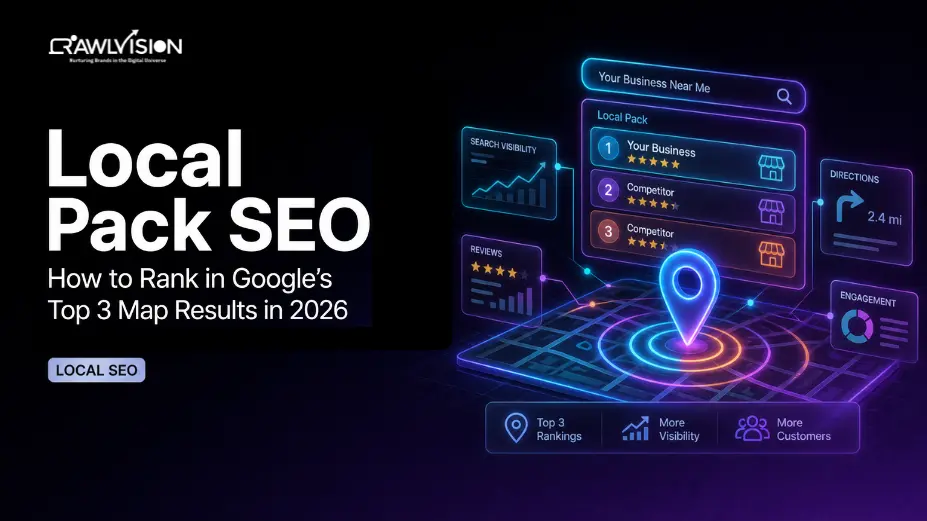
Every day, millions of people open Google and type something like ‘dentist near me,’ ‘best pizza in downtown,’ or ‘AC repair Jaipur.’ And before they see a single organic result, they see a map with three business listings in the Local Pack SEO. This prime real estate at the top of Google Search drives a staggering share of local business traffic, calls, and footfall.
If your business isn’t in those top three positions, you’re invisible to most of these searchers. The question every local business owner and marketer asks is: how do you get there? This guide gives you the complete, actionable answer backed by how Google’s local algorithm actually works in 2026.
What Is the Google Local Pack SEO And Why Is It So Valuable?
The Google Local Pack SEO (also called the Map Pack or 3-Pack) is a block of three business listings that appears at the top of Google’s search results for local queries. It includes a map, business names, star ratings, addresses, phone numbers, and links to directions or websites.
It’s valuable for one simple reason: it appears above all organic results. Users see it first. Studies show the Local Pack captures a dominant majority of clicks on local search result pages. A business in position 1 of the Local Pack often gets more traffic than the #1 organic result below it.
In 2026, with voice search, AI-powered search assistants, and mobile-first browsing dominating consumer behaviour, appearing in the Local Pack has become more critical than ever for any business with a physical presence or a defined service area.
Must Read:- Google’s February 2026 Discover Core Update: What Changed and What It Means
How Google’s Local Pack SEO Algorithm Works
Google uses a distinct algorithm for local results compared to traditional organic search. While hundreds of factors play a role, Google has officially stated that three core pillars determine local ranking:
1. Relevance: does your business match the search?
Relevance is about how well your Google Business Profile matches what the user is searching for. Google reads your business category, description, services, attributes, and even the content of your reviews to determine relevance. A plumber who lists only ‘Plumbing’ in their GBP will be less relevant for ’emergency pipe burst repair’ than one whose profile mentions emergency plumbing services specifically.
2. Distance how close are you to the searcher?
Distance refers to how far each potential search result is from the location term used in a search, or from the searcher’s location if no location is specified. Closer businesses generally rank higher, but distance is just one of three factors, which means a well-optimized business further away can still outrank a poorly optimized business that’s closer.
3. Prominence: how well-known and trusted is your business?
Prominence is the most complex of the three factors. It reflects how well-known a business is, based on information Google aggregates from across the web, reviews, links, mentions, directory listings, press coverage, and the overall completeness and authority of your online presence. A business with 500 positive reviews, 50 quality citations, and a fully optimised GBP will rank higher than a competitor with 20 reviews and a sparse profile, even at the same distance.
Top ranking factors for the Google local pack in 2026
Google business profile completeness & category accuracy
Your GBP is the single most influential factor for Local Pack ranking. A complete profile signals trust and relevance to Google. Every empty field is a missed opportunity. Your primary category must be laser-accurate. This is what Google uses first to determine whether you’re eligible to appear for a given search query.
- Choose the most specific primary category possible
- Add all relevant secondary categories (up to 9)
- Write a keyword-rich, human-sounding business description
- List every service with individual descriptions
- Add attributes that apply to your business (wheelchair accessible, women-owned, etc.)
- Upload fresh photos consistently at a minimum of 1-2 per month
Review quantity, quality & velocity
Reviews are one of the most powerful local ranking signals in 2026. But it’s not just about having a high star rating, Google’s algorithm also looks at the number of reviews, how recently they were posted (velocity), the length and detail of review text, and whether you’re responding to them.
A business that receives 5 new detailed reviews this week will see a ranking boost. A business that got 100 reviews two years ago and hasn’t received one since will plateau or decline. Consistent, ongoing review generation is a fundamental part of Local Pack SEO strategy.
Nap consistency across the web
Your Name, Address, and Phone Number must be identical across every directory, social media profile, and web mention. Even small inconsistencies, such as ‘St.’ vs ‘Street,’ a different phone number format, dilute your local authority. Google cross-references your GBP data with data from across the web, and inconsistencies create doubt about your business’s legitimacy.
Local landing pages & on-site signals
Your website still matters for Local Pack SEO rankings. Google crawls your site to validate and supplement your GBP data. Having a well-optimized local landing page with your full NAP embedded (ideally using Local Business Schema), location-specific content, and area-relevant keywords strengthens your local relevance signal significantly.
Behavioural signals ctr, calls & direction requests
Google watches how users interact with your profile. A high click-through rate from search results, a high volume of calls, and frequent direction requests all signal to Google that your business is genuinely popular and relevant. This is why keeping your profile compelling with great photos, a strong review rating, and accurate information directly impacts your ranking.
Local link signals
Backlinks from locally relevant websites, local news outlets, community organisations, chamber of commerce listings, and local bloggers signal geographic authority to Google. A business that earns links from other entities in the same city or region builds prominence that directly influences Local Pack SEO rankings.
Advanced local pack SEO tactics for 2026
- Publish weekly GBP posts to maintain profile freshness. Google’s algorithm favours active profiles
- Use the Q&A section strategically with keyword-rich answers to common questions
- Enable messaging and maintain a fast response time. Google tracks this as an engagement signal
- Build citations on high-authority directories: Google, Bing Places, Apple Maps, Justdial, Sulekha, IndiaMart (for Indian businesses)
- Implement LocalBusiness Schema Markup on your website to give Google structured, machine-readable location data
- Geo-tag your GBP photos before uploading, using tools like GeoImgr for additional location signals
- Monitor your Local Pack SEO position with tools like BrightLocal or Whitespark’s Local Rank Tracker

