

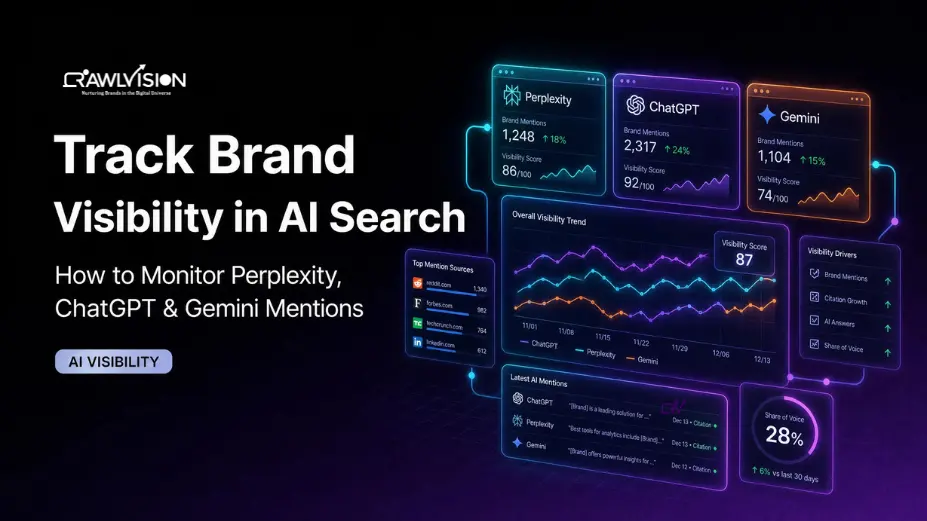
The SEO game has changed. Millions of users now search for brands, products, and services directly inside ChatGPT, Perplexity, and Google Gemini, and if your brand is not showing up there, you are invisible to a massive and growing audience. This free guide shows you exactly how to track your brand’s visibility in AI search engines using Generative Engine Optimization (GEO) and Answer Engine Optimization (AEO) without spending a single rupee on paid tools.
1. Why AI search brand visibility matters in 2026
Traditional search engine optimization taught us to rank on Google’s blue links. But the rise of AI-powered search engines like Perplexity AI, ChatGPT Search, and Google Gemini has fundamentally changed how users discover brands. Instead of clicking 10 links, users now get one synthesised answer, and if your brand isn’t in that answer, your competitor is.
According to recent industry data, over 400 million people use ChatGPT monthly. Perplexity is growing at a rate of 50%+ year-over-year. Google Gemini is being embedded into Android and Google Workspace. Brand visibility in AI search is no longer optional; it is a business-critical KPI.
| KEY INSIGHT | When someone types “best digital marketing agency in Mohali” into Perplexity or ChatGPT, the AI does not search Google; it synthesises from its training data, web-crawled content, and real-time sources. Your brand must be referenced in authoritative, AI-crawlable content to be included in these answers. |
| ChatGPT Search | Perplexity AI | Google Gemini |
| 400M+ monthly users. Uses Bing index + training data. Now includes real-time web browsing. | Growing rapidly among researchers & professionals. Cites sources making brand mentions traceable. | Integrated into Google Search (AI Overviews) and Workspace. Draws from Google’s full index. |
2. Understanding geo vs aeo vs SEO
Before building your monitoring strategy, you need to understand the three pillars of modern search visibility. GEO (Generative Engine Optimization), AEO (Answer Engine Optimization), and traditional SEO all work together but serve different purposes.
| Dimension | Traditional SEO | AEO | GEO |
|---|---|---|---|
| Target Platform | Google, Bing SERP | Featured Snippets, Voice Search | ChatGPT, Perplexity, Gemini |
| Content Format | Keyword-dense pages | Question-answer structure | Entity-rich, citable, authoritative |
| Key Signal | Backlinks, Core Web Vitals | Schema markup, FAQ pages | Brand mentions, E-E-A-T, citations |
| Measurement | Keyword ranking, organic traffic | Featured snippet wins | Brand mention frequency in AI output |
| Free Tools | Many Available | Limited | Manual + Emerging Tools |
| PRO TIP | A strong SEO foundation directly fuels GEO and AEO performance. High-authority backlinks, structured content, and E-E-A-T signals all contribute to whether AI engines include your brand in their responses. |
3. Step-by-step: track brand visibility in AI search (free methods)
You do not need expensive tools to start monitoring your brand in AI search. Here is a complete, free AI search brand monitoring framework you can implement today.
Method 1: manual prompt testing (the foundation)
The most direct way to check your brand visibility in AI engines is to manually query them. Create a brand monitoring prompt list with 20–30 queries across three categories:
| 1 | Direct Brand Queries
Example: “Tell me about [Your Brand Name]” Tests whether the AI has brand awareness from training data. |
| 2 | Category & Competitor Queries
Example: “Best SEO agencies in Mohali” Tests whether your brand appears in category-level recommendations. |
| 3 | Problem-Solution Queries
Example: “How to improve local SEO for a restaurant?” Tests whether your content is being cited as an expert source. |
| SAMPLE MONITORING PROMPT TEMPLATE
User Query: “What are the best free tools to track brand mentions in AI search engines in 2026?” What to look for: • Is your brand name mentioned in the response? • Is your website cited as a source? • Are competitors mentioned instead of you? • Is the response based on recent content (post-2024)? |
Run these prompts weekly in Perplexity AI, ChatGPT, and Google Gemini, and log results in a spreadsheet for accurate trend tracking.
Method 2: Google alerts + brand mention tracking
Set up Google Alerts for your brand name, variations, and key products. When AI engines like Perplexity cite web sources, those citations often come from sites that have published content about your brand. Tracking where your brand is mentioned online directly impacts your AI search citation frequency.
- Set Google Alerts for: “[Brand Name]”, “[Brand Name] + review”, “[Brand Name] + alternative”
- Track mentions weekly in a Google Sheet with columns: Source, Date, Sentiment, AI-Visible (Y/N)
- Prioritize mentions from high-DA sites (DA 40+) as these are more likely to be cited by AI engines
- Use Google Search Console to track branded keyword impressions and clicks monthly
Method 3: perplexity’s cited sources feature
Perplexity AI is particularly valuable because it shows its sources. When you run a query in Perplexity, you can see exactly which websites it cited to build the response. This makes it the most transparent AI search engine for brand citation monitoring.
| PRO TIP | In Perplexity, after running a brand query, click “Sources” to see all cited URLs. If your site never appears for relevant queries, focus on getting more inbound links from sites that Perplexity regularly cites typically industry publications, Wikipedia, Reddit, and authoritative blogs. |
Method 4: track AI overviews in Google search
Google’s AI Overviews (powered by Gemini) now appear for over 15% of all search queries. Track your brand’s appearance in AI Overviews using these two free approaches:
| A | Use Google Search Console
Filter by queries where you rank in positions 1–5. AI Overviews frequently pull from top-ranked pages. If you rank but are not cited, your content may lack proper structured data or E-E-A-T signals. |
| B | Manual SERP Checking
Search your 20 top target keywords in Google (incognito mode). Screenshot all AI Overviews. Check if your brand or content is cited in the overview panel. |
4. How to improve your brand’s visibility in AI search (geo strategy)
Tracking is only half the battle. Once you know where you stand, you need a Generative Engine Optimization strategy to improve your brand’s AI search presence.
1. Build entity authority (the core of geo)
AI engines understand the world through entities named people, brands, places, and concepts. To be recognized by ChatGPT, Perplexity, and Gemini, your brand must be established as a distinct, well-documented entity on the web.
- Create and optimize your Wikidata entity for your brand (free, highly influential for AI training data)
- Get published on industry publications, press releases, and authoritative news sites
- Ensure consistent NAP (Name, Address, Phone) across all platforms for local GEO
- Build a strong Google Business Profile. Gemini pulls heavily from this for local brand queries
- Use structured data markup (Schema.org: Organization, Person, Local Business schemas)
2. Create citable, expert-level content (aeo content strategy)
AI engines prefer to cite content that is comprehensive, factual, and structured as direct answers. Reformat your best content using these AEO principles:
- Question-First Structure: Start sections with the exact question users ask. AI engines pattern-match questions to your headings.
- Include Original Data: Statistics, case studies, and original research are highly cited by AI engines as they provide verifiable facts.
- Clear, Structured Answers: Use numbered lists, comparison tables, and short definition paragraphs that AI engines can easily extract.
3. Earn mentions on AI-crawled sources
AI engines prioritize content from specific types of sources. To improve your brand’s AI search visibility, earn mentions and links from:
- Industry-leading publications and news sites (guest posts, expert quotes)
- Reddit communities relevant to your niche (contribute organically, never spam)
- YouTube videos with transcripts (Gemini indexes YouTube content heavily)
- Podcast appearances (transcripts are highly crawlable by AI engines)
- Wikipedia mentions (extremely high AI citation rate, even indirect mentions help)
5. Free tools to build your AI brand monitoring stack
| Tool | Use Case | Cost | AI Monitoring Value |
|---|---|---|---|
| Google Search Console | Track branded queries, AI Overview impressions | Free | ★★★★★ |
| Google Alerts | Brand mention monitoring | Free | ★★★★ |
| Perplexity AI (Free) | Manual brand query testing with source citations | Free | ★★★★★ |
| ChatGPT (Free tier) | Brand awareness testing in GPT-4o mini | Free | ★★★★ |
| Google Gemini (Free) | AI Overview and Gemini response testing | Free | ★★★★ |
| Ahrefs Free Tools | Backlink checker, keyword research for GEO content | Free (limited) | ★★★ |
| Google Sheets | Build your AI visibility tracking dashboard | Free | ★★★★ |
6. Building your free AI brand visibility dashboard
Create a Google Sheet with the following structure and update it weekly for accurate trend data:
| 1 | Tab 1: Query Log
Columns: Query | Platform (ChatGPT/Perplexity/Gemini) | Brand Mentioned (Y/N) | Brand Cited as Source (Y/N) | Competitor Mentioned | Date | Notes |
| 2 | Tab 2: Brand Mention Sources
Columns: Mentioning Website | DA/DR Score | Date | Sentiment | Perplexity Cites This Site (Y/N) | Action Required |
| 3 | Tab 3: Google Search Console AI Overview Tracking
Export GSC data monthly. Filter for queries where AI Overviews appear. Track impressions, clicks, and CTR trends for these branded and non-branded queries. |
| 4 | Tab 4: Monthly Scorecard
Track: Brand Mention Rate (%) in AI responses | Total AI Citations | Competitor Presence Score | Month-over-Month Change |
7. Local geo: tracking brand visibility for local businesses
If you serve a local market, Local GEO optimization is critical. When users ask ChatGPT or Gemini “best restaurant near me” or “top SEO agency in Mohali,” AI engines pull from local data sources, including Google Business Profile, local directory listings, and review platforms.
- Ensure your Google Business Profile is fully optimized with posts, photos, Q&A, and services. Gemini AI reads this directly
- Get consistent citations on JustDial, IndiaMart, Sulekha, and other Indian local directories
- Earn reviews that mention your service category and location naturally (e.g., “best SEO agency in Mohali”)
- Publish locally-targeted content: “Top Digital Marketing Trends in Punjab 2026” AI engines cite hyper-local expert content
- Use Local Business Schema with geo-coordinates on your website
| LOCAL GEO | Test queries in Gemini with location context like “digital marketing expert in Mohali.” Gemini uses your Google Business Profile data, local pack rankings, and map data to build these responses. A fully optimized GBP profile is your #1 local GEO asset. |
8. Advanced aeo: optimizing for voice & conversational AI queries
Answer Engine Optimization is not just about featured snippets anymore. As voice search and conversational AI assistants grow, your content must be optimized for how people speak, not just how they type.
- Target long-tail, conversational keywords: “how do I”, “what is the best way to”, “can you explain.”
- Create a dedicated FAQ page using Google’s FAQ Schema guidelines
- Write content at a Flesch-Kincaid reading ease of 60+ (simple, clear sentences)
- Use “The answer is…” or “To summarize…” intro sentences AI engines love directly extractable answer phrases
- Include a “Quick Answer” box at the top of every blog post (under 60 words) that summarizes the main takeaway
- Optimize for “People Also Ask” in Google PAA questions, which are training signals for AI engines

