

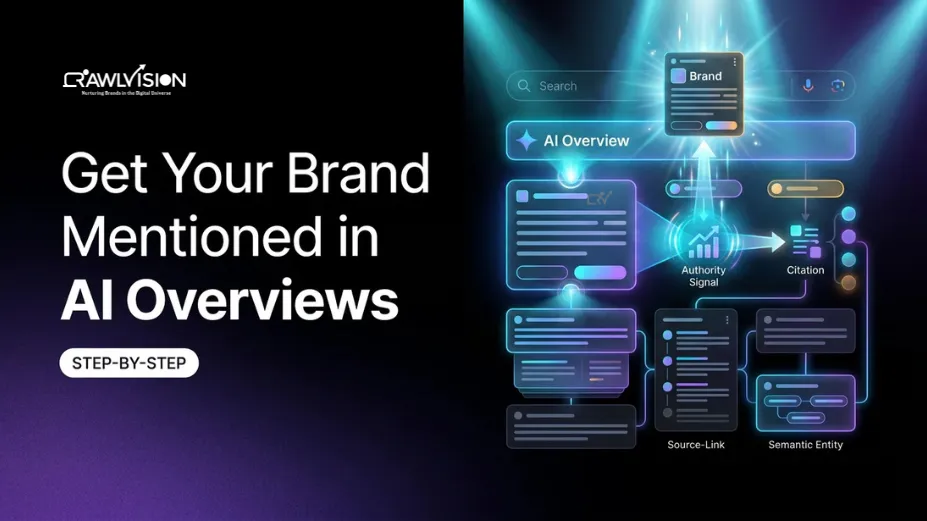
If you’ve searched Google lately, you’ve noticed it: before the traditional blue links, there’s now an AI-generated summary at the very top of the page. That’s Google’s AI Overviews, and it’s fundamentally changing who gets seen, who gets clicked, and who gets ignored.
The brands showing up in these AI-generated summaries aren’t there by accident. They’ve earned their spot through specific content, authority, and technical signals that make them citation-worthy to AI systems. And the good news is you can replicate their approach.
This step-by-step framework will show you exactly how to get your brand mentioned in AI Overviews, as well as in ChatGPT, Perplexity, and Google AI Mode.
Why getting brand mentioned in AI overviews matters
Before diving into the framework, it’s important to understand what’s at stake. AI Overviews now appear at the top of a large percentage of Google search results. Users read these summaries and often make decisions based on them without ever clicking a traditional search result.
Brands that get mentioned in AI Overviews benefit from:
- Increased brand awareness even in zero-click searches
- Higher trust signals being cited by AI imply authority
- Traffic from users who click through to learn more
- Competitive advantage, as most brands haven’t optimized for AI citation yet
On the flip side, brands that are consistently absent from AI-generated answers are losing share of voice quietly, and at scale.
The 8-step framework to get your brand mentioned in AI overviews
| Step 1 | Audit Your Current AI Visibility
Before optimizing, know where you stand. Run 20–30 queries relevant to your business in ChatGPT, Perplexity, Google AI Overviews, and Google AI Mode. Record whether your brand appears, how it’s described, and which competitors are being cited instead. |
| Step 2 | Build and Strengthen Your Brand Entity
AI models rely on entities with clearly defined subjects and verified attributes. To be cited, your brand needs to be recognized as a trusted entity. Implement Organization schema markup on your homepage. Ensure your brand name, description, and category are consistent across your website, Google Business Profile, social media profiles, and third-party directories. |
| Step 3 | Create Direct-Answer Content
AI Overviews favor content that answers questions clearly, concisely, and directly. Rewrite your key articles so that the main answer appears in the first 100 words. Use question-based H2 headings (e.g., ‘What is [topic]?’, ‘How does [process] work?’). Add an FAQ section at the end of every major article. |
| Step 4 | Strengthen Your E-E-A-T Signals
Google’s AI systems rely heavily on E-E-A-T (Experience, Expertise, Authoritativeness, Trustworthiness) to determine which sources to cite. Add detailed author bios with credentials and real-world experience. Cite authoritative sources within your content. Earn editorial coverage from recognized publications in your industry. Display trust signals: certifications, case studies, client logos, testimonials. |
| Step 5 | Implement Structured Data (Schema Markup)
Structured data helps AI systems understand your content at a machine-readable level. Add relevant schema types: Article, FAQPage, HowTo, Organization, Product, and Local Business (where applicable). Use Google’s Rich Results Test to validate your implementation. Ensure your schema accurately reflects the content on the page. |
| Step 6 | Build a Third-Party Brand Presence
AI models don’t only look at your website. They synthesize information from across the web. Get featured in industry publications, roundup articles, and authoritative blogs. Participate in relevant Reddit communities. Create educational YouTube content. Contribute to Wikipedia entries where genuinely relevant. Earn mentions in podcasts, webinars, and news articles. |
| Step 7 | Keep Your Content Fresh and Updated
AI Overviews prefer current, up-to-date content. Audit your top pages quarterly. Update statistics, examples, and recommendations. Add a visible ‘Last Updated’ date. For rapidly changing topics, consider adding a ‘Key Takeaways’ box at the top of each article that summarises current best practices. |
| Step 8 | Track, Measure, and Iterate
Getting your brand mentioned in AI Overviews is an ongoing effort, not a one-time optimization. Use prompt tracking tools or manual audits to monitor your AI citation performance weekly. Compare your presence against competitors. Identify which content pieces earn citations and create more like them. Track which prompts still return zero mentions of your brand and prioritize content for those gaps. |
Content formats that get cited most in AI overviews
Not all content is equal when it comes to AI citation. Based on current data, these formats earn citations in AI Overviews most frequently:
| Content Format | Citation Rate | Best For |
| Listicles / Roundups | High (21.9%) | Informational, comparison queries |
| In-depth Articles | High (16.7%) | Educational, how-to content |
| Product / Service Pages | Medium (13.7%) | Commercial intent queries |
| FAQ Pages | High | Direct question queries |
| HowTo Guides | High | Step-by-step process queries |
Common mistakes that prevent brand mentions in AI overviews
- Writing for traditional SEO only long, keyword-heavy content without direct answers
- Weak entity signals inconsistent brand names, no schema markup, and no Knowledge Panel
- No third-party presence AI systems can’t corroborate your brand from other sources
- Stale content, outdated information, makes AI systems hesitant to cite your site
- Missing FAQ or HowTo structure these formats directly feed AI answer generation
- No E-E-A-T signals no author credentials, no external validation, no trust proof

