


Schema markup is one of the most powerful tools for AI search optimization in 2026. Learn what structured data is, which schemas matter most, and how to implement JSON-LD to get cited in Google AI Overviews and other AI search engines.
What is schema markup and why does it matter in 2026?
Schema markup (also called structured data) is code that you add to your webpage to help search engines understand the meaning and context of your content. Rather than forcing Google to interpret what your page is about, schema markup explicitly tells it: ‘This is an article written by [author] on [date] about [topic],’ or ‘This is a FAQ with these specific questions and answers.’
In 2026, schema markup has taken on a new level of importance because AI-powered search systems, such as Google AI Overviews, ChatGPT, Perplexity, and others, rely heavily on structured data to identify, understand, and cite content. Pages with comprehensive schema markup are significantly more likely to be featured in AI-generated answers.
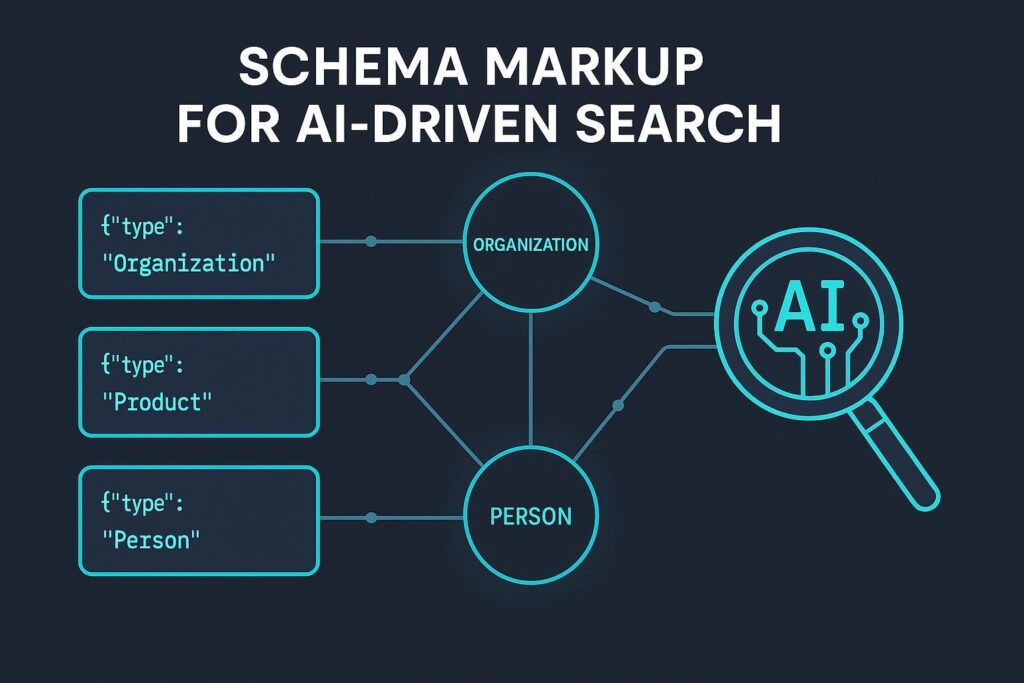
The most important schema types for AI search in 2026
1. Article schema
Article schema is fundamental for any blog post or news article. It tells AI systems the article’s headline, author, publication date, last modified date, and the organization that published it. These signals directly support E-E-A-T evaluation. Always include ‘author’ with a Person schema nested inside, and link the author’s ‘same As’ property to their LinkedIn or Wikipedia page.
2. Faq schema
The FAQ schema is one of the highest-value schema types for AI search. When you mark up an FAQ section with structured data, search engines and AI systems can directly extract individual Q&A pairs and use them in generative answers. Every blog post with an FAQ section should have the FAQ schema implemented.
3. Howto schema
How To schema explicitly marks up step-by-step instructional content. AI systems love step-by-step content because it is highly actionable and directly answers ‘how to’ queries. Use How To schema on any article that walks readers through a process.
4. Organization and person schema
These schemas establish your entity identity to search engines. Organization schema on your homepage and About page tells Google who you are, what you do, and provides verification signals through your social media profiles (same As property). Person schema on author profile pages establishes individual E-E-A-T signals.
5. Breadcrumblist schema
Breadcrumb schema helps AI systems understand your site’s hierarchical structure and how individual pages relate to broader topic areas. This supports topical authority signals and helps AI navigate your content cluster architecture.
6. Product and review schema (for e-commerce)
If you operate an e-commerce or product-focused site, Product schema with aggregate Rating is critical. AI shopping assistants increasingly use structured product data to power recommendations and comparisons.
Read More:- Biggest announcements made by Google in 2025
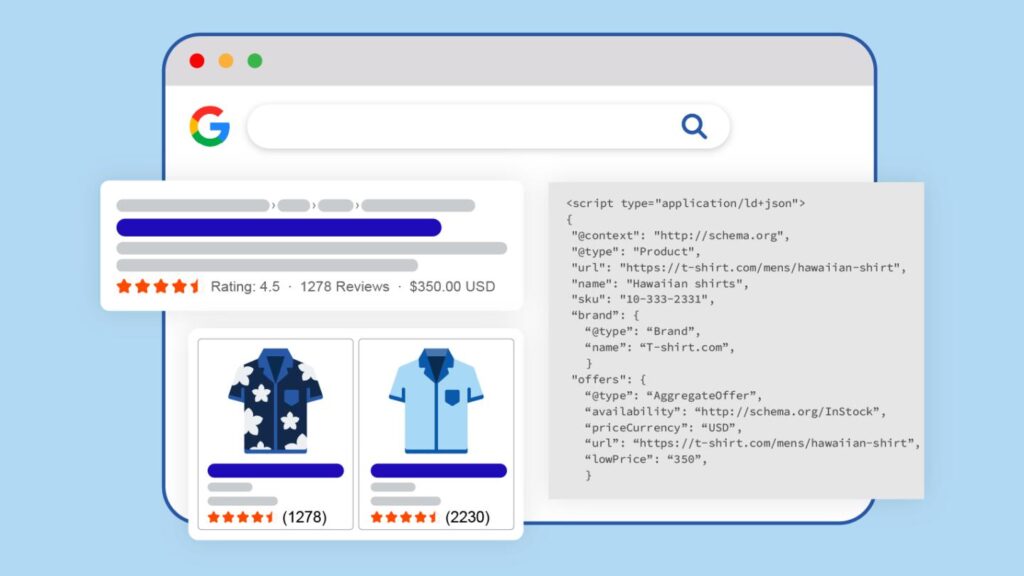
How to implement json-ld schema markup: step-by-step
- Choose the appropriate schema type(s) for your page content from schema.org.
- Write your JSON-LD code. This is the preferred implementation method recommended by Google.
- Place the JSON-LD code within a <script type=’application/ld+json’> tag in the <head> section of your HTML.
- Test your implementation using Google’s Rich Results Test tool (search.google.com/test/rich-results).
- Verify in Google Search Console’s Enhancements section that your structured data is being detected correctly.
- Monitor for errors or warnings and fix any issues that appear.
- Regularly update your schema data as your content changes, especially dates, ratings, and pricing information.
Advanced schema tips for geo optimization
- Use the ‘about’ and ‘mentions’ properties in the Article schema to explicitly declare what entities your content covers. This strengthens your relevance for entity-based queries
- Include ‘same As’ properties linking to authoritative external sources like Wikipedia, Wikidata, and official social profiles
- Nest multiple schema types within a single JSON-LD block, for example, nest the Person schema inside the Article’s ‘author’ property
- Use ‘speakable’ schema to optimize content for voice search and AI assistants
- Add ‘date Modified’ to all article schemas and keep it current. Freshness signals matter for AI citation
- For multi-step processes, use How To with detailed Step objects, including images and estimated time
Read More:- Google Lists 9 Scenarios That Explain How It Picks Canonical URLs
Common schema markup mistakes to avoid
- Marking up content that is not visible on the page, Google may penalise invisible schema
- Using incorrect or outdated schema property names always verify against schema.org
- Implementing schema inconsistently across similar page types
- Forgetting to update the schema when the page content changes
- Using Microdata instead of JSON-LD is Google’s preferred format, and easier to maintain
- Ignoring schema validation errors in Search Console