Table of Contents
TogglePerplexity AI is growing fast as an alternative to Google Search. Learn how Perplexity works, how it differs from Google, and how to optimize your content for visibility on both platforms in 2026.
The rise of perplexity AI as a search engine
Perplexity AI has rapidly grown to become one of the most significant AI-powered search engines in 2026. Unlike ChatGPT, which started as a chatbot and added search functionality, Perplexity was built from the ground up as an ‘answer engine’, a platform designed to give users direct, cited answers to their questions.
With tens of millions of active users and growing, Perplexity represents a meaningful new traffic source for websites that understand how to optimize for it. More importantly, studying Perplexity reveals key insights into how all AI-powered search engines fundamentally work.
How perplexity AI works: the answer engine model
Perplexity operates as what it calls an ‘answer engine.’ When a user submits a query, Perplexity searches the web in real-time, reads multiple sources, synthesizes the information into a coherent answer, and presents it with numbered citations that users can click to verify.
This model is transparent about its sources in a way that Google AI Overviews are not, making it popular among users who want verifiable, research-backed answers. For website owners, this transparency is also an opportunity as Perplexity citations can drive highly qualified, intent-driven traffic.
Read More:- The Death of “Top-of-Funnel Traffic”: What To Measure Instead in 2026
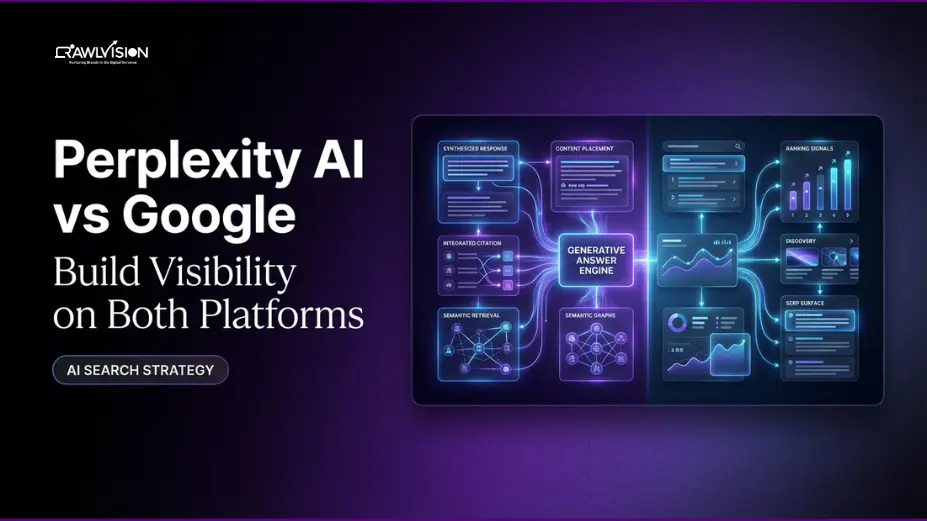
Perplexity AI vs Google: key differences
Search results format
Google shows a list of ranked links (plus AI Overviews for some queries). Perplexity always shows a synthesized AI answer with inline numbered citations no traditional SERP. Every answer is generatively produced.
Ranking signals
Google uses hundreds of ranking signals, including PageRank, Core Web Vitals, and keyword relevance. Perplexity prioritises source authority, content recency, direct question-answering ability, and factual accuracy as its primary citation selection criteria.
User intent
Google serves a wide range of intents: navigational, transactional, and informational. Perplexity primarily serves informational and research intent. Users come to Perplexity wanting to understand or learn something, not to buy products or navigate to a specific website.
Traffic model
Google’s primary value is click-through traffic to your website. Perplexity sends less raw traffic, but the users who do click are highly engaged and research-oriented, often resulting in higher conversion rates for appropriate content types.
Content freshness
Google balances freshness with authority for most queries. Perplexity strongly favors fresh content, often citing articles published within the last few days or weeks for trending or news-adjacent topics.
How to optimize for perplexity AI
- Ensure your site is indexed. Perplexity uses multiple crawlers, including Perplexity Bot. Check your robots.txt to ensure Perplexity Bot is not blocked.
- Write content that directly answers specific questions. Perplexity rewards content that clearly states the answer upfront.
- Cite credible sources and statistics within your content. Perplexity trusts content that demonstrates factual rigor.
- Keep content fresh and regularly updated. Perplexity strongly favors recently published or updated content.
- Build domain authority through quality backlinks. Perplexity uses domain authority as a key trust signal.
- Use clear content structure with descriptive H2/H3 headings helps Perplexity’s AI extract the relevant section for each query.
- Include original research, data, and unique insights that Perplexity cannot find anywhere else. This is the most powerful differentiation strategy.
Read More:- Semrush at a Crossroads: Major Acquisition, AI-Driven Features, and What It Means for SEO in 2025
How to optimize for both perplexity AI vs Google simultaneously
The good news is that optimizing for Perplexity and Google has a significant overlap. Content that is well-structured, authoritative, comprehensive, and directly answers user questions performs well on both platforms.
The key differences are: for Google, prioritize technical SEO, backlink building, and Core Web Vitals; for Perplexity, prioritise content freshness, factual citations within your content, and direct question-answering above all else. A unified strategy that does both will maximise your total search visibility across AI and traditional search platforms.